The fall begins where the surface shows almost nothing
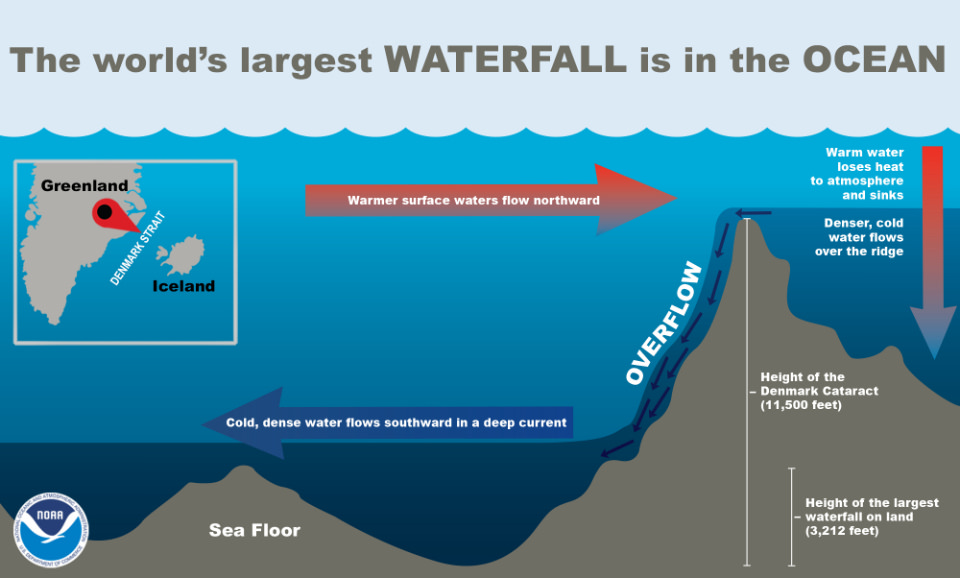
Original infographic: NOAA National Ocean Service, a United States government work. The Archive stores the image locally; interactive labels and motion are separate interface elements.
The word waterfall creates the wrong first picture. There is no exposed cliff, no white curtain and no roar above the waves. The entire event happens inside the ocean.
North of the ridge between Greenland and Iceland, water from the Nordic Seas becomes cold and dense. It moves south at depth. When it reaches the submerged sill of the Denmark Strait, it crosses the ridge and descends along the continental slope beneath warmer, lighter Atlantic water.
The exact number depends on which points define the top and bottom of the cataract. Either way, the vertical change is more than three times the height of Angel Falls.
Long-term moorings place the mean transport near 3.2 sverdrups. One sverdrup equals one million cubic metres per second.
The turbulence remains submerged. A vessel may cross the region without seeing the planetary-scale transfer taking place below.
How water falls through water
Density is the mechanism. Seawater becomes denser when it cools and, within the relevant range, when its salinity increases. The colder overflow water can therefore move beneath warmer Atlantic water just as a heavy fluid slides under a lighter one.
The slope is only the beginning
As the dense plume descends, it entrains surrounding water. Its volume increases while its temperature and salinity change. By the time the current reaches the deep North Atlantic, it is no longer exactly the water mass that crossed the sill. The cataract is also a mixing machine.
The Coriolis effect and the shape of the seafloor steer the flow along Greenland’s continental margin. Pulses, eddies and meanders make its short-term transport highly variable. Instruments can record large swings over hours even though the long-term mean is comparatively stable.
Dr Ingrid Rahbek · overflow monitoring group · recovery note 12Archive reconstruction. A clearly marked fictional research layer of Code Gaia.The instrument came back with a year of velocity, temperature and pressure. No image of a waterfall. Just columns of numbers.
At first glance the transport jumped too violently to belong to a system described as stable. Then we averaged longer.
The hours fought each other. The years did not.
If we had sampled once, we could have reported almost any ocean we wished to find.
Why this hidden current matters outside the strait
The Denmark Strait overflow supplies a major part of the dense water that enters the North Atlantic from the Nordic Seas. After crossing the ridge, the current mixes with neighbouring water and contributes to North Atlantic Deep Water.
This deep southward flow is one component of the Atlantic overturning circulation: a larger system that redistributes heat, freshwater, dissolved gases and nutrients. Calling the cataract “the engine of the Gulf Stream” would be too simple. Wind, surface buoyancy, several deep-water sources and basin geometry all participate. Removing the Denmark Strait overflow from the story, however, would remove one of the Atlantic’s largest dense-water gateways.
Water does not free-fall through an empty space. It forms a dense gravity current that runs down a long submerged slope. The spectacular height and transport figures are valid descriptions of the path and volume, not evidence of a vertical abyss beneath one point on the surface.
Malik Nordin · coupled-ocean laboratory · experiment 44Archive reconstruction. A clearly marked fictional research layer of Code Gaia.We reduced the overflow in the model and waited for the Atlantic to answer.
It did not stop like a machine with a severed cable. It reorganised. Other pathways changed, mixing changed, the deep return flow adjusted.
That was less reassuring than a clean failure.
A system with alternatives can resist damage. It can also hide the damage by distributing it.
Can the waterfall weaken?
The overflow is observed by moored instruments because a few expeditions cannot resolve its variability. Measurements since the 1990s show substantial fluctuations at short timescales. They also show that separating a long-term trend from natural variability is difficult.
Warming, freshening and changes in the waters that feed the strait can alter density and transport. But a dramatic headline about the entire Atlantic circulation cannot be inferred from one month—or even one branch—alone. The open scientific problem is how changes upstream propagate through mixing, other overflow routes and the wider overturning system.
What is established—and what remains open
| Status | Finding | Basis |
|---|---|---|
| Confirmed | Dense water descends from the Denmark Strait sill into the deep Atlantic | Hydrographic surveys, current meters and long-term moorings directly measure the overflow. |
| Confirmed | The descent exceeds three kilometres | Bathymetry places the sill and downstream basin thousands of metres apart in depth. |
| Confirmed | Mean transport is roughly 3.2 million m³/s | Revised estimates from the long moored time series place the average near 3.2 Sv. |
| Confirmed | The overflow contributes to North Atlantic Deep Water | Water-mass properties and circulation observations trace it downstream. |
| Unresolved | How future source-water changes will alter the overflow | Transport, density and mixing respond on different timescales and through multiple pathways. |
| Misleading | A vertical wall of water exists beneath one location | The flow follows a broad, sloping seabed and mixes as it descends. |
The honest verdict
The Denmark Strait cataract earns its title by scale: more than three kilometres of descent and millions of cubic metres of water each second. Yet its deeper importance is not the record. It is the mismatch between surface appearance and hidden transport.
A calm-looking ocean can move a continent-sized volume below the reach of sight. To observe it, scientists anchor instruments in darkness and reconstruct the current from pressure, temperature and motion.
The ocean makes continents tremble continuously
CG-057 · GEOPHYSICAL SIGNALSA storm can be detected far from the waterWhen opposing ocean waves interact, part of their energy enters the seafloor. Seismographs on land record the resulting microseismic background even when no earthquake has occurred.
Open dossier →If submerged flow can reshape the deep Atlantic, which of its movements can the solid Earth record?