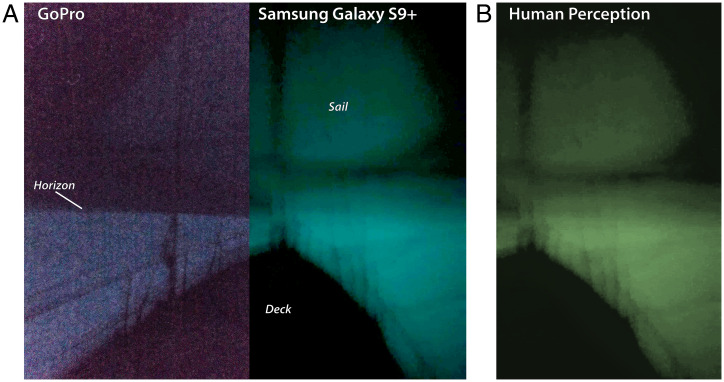
At about 21:00 on 2 August 2019, the 16-metre yacht Ganesha was sailing from Lombok toward the Cocos Islands. There was no Moon. The crew entered a sharply different expanse of water: a steady pale glow reached to the horizon, while the bow wave appeared dark.
They remained inside it until dawn—about eight hours. The event was not a bright wake or a few flashes stirred by the hull. The entire visible sea was luminous.
The ocean passed three tests
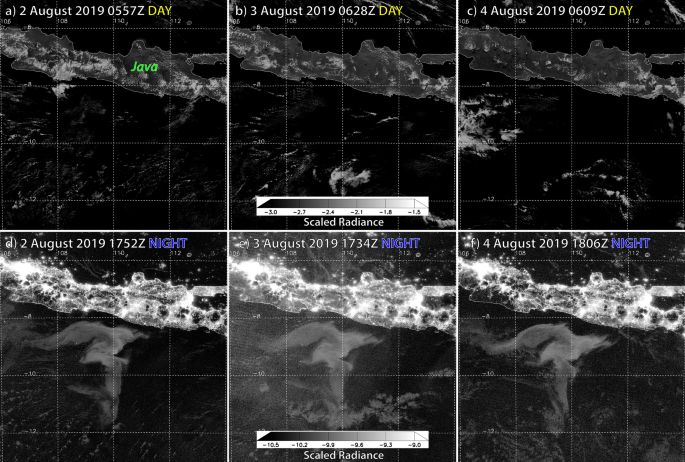
The Day/Night Band on Suomi NPP and NOAA-20 is designed to measure extremely faint visible light at night. A bright patch in a single frame would prove little: clouds, atmospheric airglow, moonlight and fishing fleets can all imitate a signal.
The Java feature behaved differently. It was absent in daytime imagery, returned over successive moonless nights, moved with the analysed surface currents and did not track the changing cloud field. Researchers followed it across two moon-free intervals from late July into early September.
A ship crossed the satellite image
Years after the event, a crew member learned about the satellite study and contacted the researchers. GPS positions placed Ganesha across the southern edge of the luminous area at the reported time. Satellite radiance increased where the yacht entered it.
The boat had not crossed the brightest region. Roughly 200 kilometres north of its track, the satellite measured radiance four to five times stronger. Even at the weaker edge, the crew described the ocean as brighter than the night sky.
Dr Lian Moreau · low-light imagery desk · 28 July 2019A clearly labelled fictional research layer of Code Gaia.Night one could be airglow. Night two could still be an artefact.
Then the boundary returned, displaced with the current but intact. Daylight showed ordinary ocean. Clouds crossed it and vanished; the light beneath remained.
We were no longer looking for a bright pixel. We were following a body of water.
This is not the familiar sparkle in a wave
Common disturbed-water bioluminescence
Often produced by dinoflagellates. Movement triggers brief flashes around waves, hands or a vessel's wake.
Milky sea
A broad, mostly uniform and steady glow that can persist in calm water without mechanical stimulation.
Luminous bacteria are the leading explanation. In the only chance research-vessel encounter, east of Socotra in 1985, samples found Vibrio harveyi associated with the microalga Phaeocystis. Laboratory work shows that some luminous bacteria switch on light production after their population—and the signalling molecules they release—cross a critical density. This process is called quorum sensing.
But that mechanism does not identify the organisms in the 2019 Java event. No equipped research vessel reached it. The satellite measured light, the yacht documented appearance, and neither collected the chemical, genetic and depth profiles needed to establish the event's composition.
The largest number is an estimate
The 2021 study estimated roughly 6×10²² to 6×10²³ luminous bacteria for the Java event by applying plausible cell densities to the observed area. It is a scale calculation, not a direct cell count. The event was never sampled scientifically.
What the darkness in the bow wave changes
The crew drew up a bucket of glowing water. It contained steady points of light that dimmed when stirred. The bow wave also looked darker, yet the wake behind the vessel did not. Those observations run opposite to the familiar flash triggered by disturbance.
The captain believed the glow came from below the surface. That recollection is useful but cannot determine depth. The light may have occupied a volume of water rather than a thin surface film, or several milky-sea structures may exist. Only vertical measurements inside an active event can decide.
Dr Samir Okoye · rapid-response planning noteA clearly labelled fictional research layer of Code Gaia.The satellite can tell us where the light is tonight. It cannot tell us which organism is producing it, how deep the luminous layer extends, or what will remain by the time a ship arrives.
Our problem is no longer finding a legend in old logbooks.
It is reaching a living event before the Moon erases it from the sensor and the current rearranges the evidence.
What is established—and what remains open
| Status | Finding | Boundary |
|---|---|---|
| Confirmed | A ≈100,000 km² luminous feature persisted south of Java in 2019 | Satellite detection was later matched to a yacht's GPS track and photographs. |
| Confirmed | The event lasted at least 45 nights | Moonlight interrupted observation; exact start and end remain unknown. |
| Supported | Luminous bacteria are the likely source of milky seas | The 2019 Java water was not scientifically sampled. |
| Hypothesis | Quorum sensing helps switch on the glow | It does not by itself explain the event's full structure, depth or persistence. |
| Open | Ecological function and formation conditions | No modern expedition has yet profiled an active event in place. |
The honest conclusion
Milky seas have moved out of maritime folklore. Satellites can identify and track them, and the 2019 Java crossing confirmed that a signal seen from orbit corresponds to the steady horizon-wide glow described by sailors.
The central uncertainty has also become sharper. We know where the water shone and how long the light persisted. We still do not know exactly which organisms built that event, how the luminous layer was arranged, or what ecological process sustained it across an area comparable to a country.
What remains after the light disappears?
CG-176 · OCEAN & DEEP SYSTEMSA Glass of Seawater Contains a List of Animals Nobody SawLight reveals a water mass only while it is glowing. Genetic fragments can expose the organisms that passed through water after direct observation has failed.
Open the next dossier →If an ecosystem appears only briefly, which record should we trust after the visible event is gone?