Imagine a raindrop over the western Amazon. It may have evaporated from the Atlantic Ocean, entered the continent with the trade winds, fallen on the forest, moved through a tree from root to crown and returned to the air. Then it may have repeated the journey.
A 2018 study traced atmospheric moisture in fifteen-minute steps on a grid of roughly 25 by 25 kilometres. The authors estimated that about 20% of all rain in the Amazon basin had been released by trees through transpiration at least once. About half of that contribution went through more than one “leaves → atmosphere → rain” cycle.
How the forest carries rain westward
This release is called transpiration. Together with evaporation from soil and other surfaces, it forms evapotranspiration. Deep roots allow Amazon trees to keep releasing moisture when rain temporarily stops. The forest acts not as a source of water, but as a chain of intermediate pumps and reservoirs.
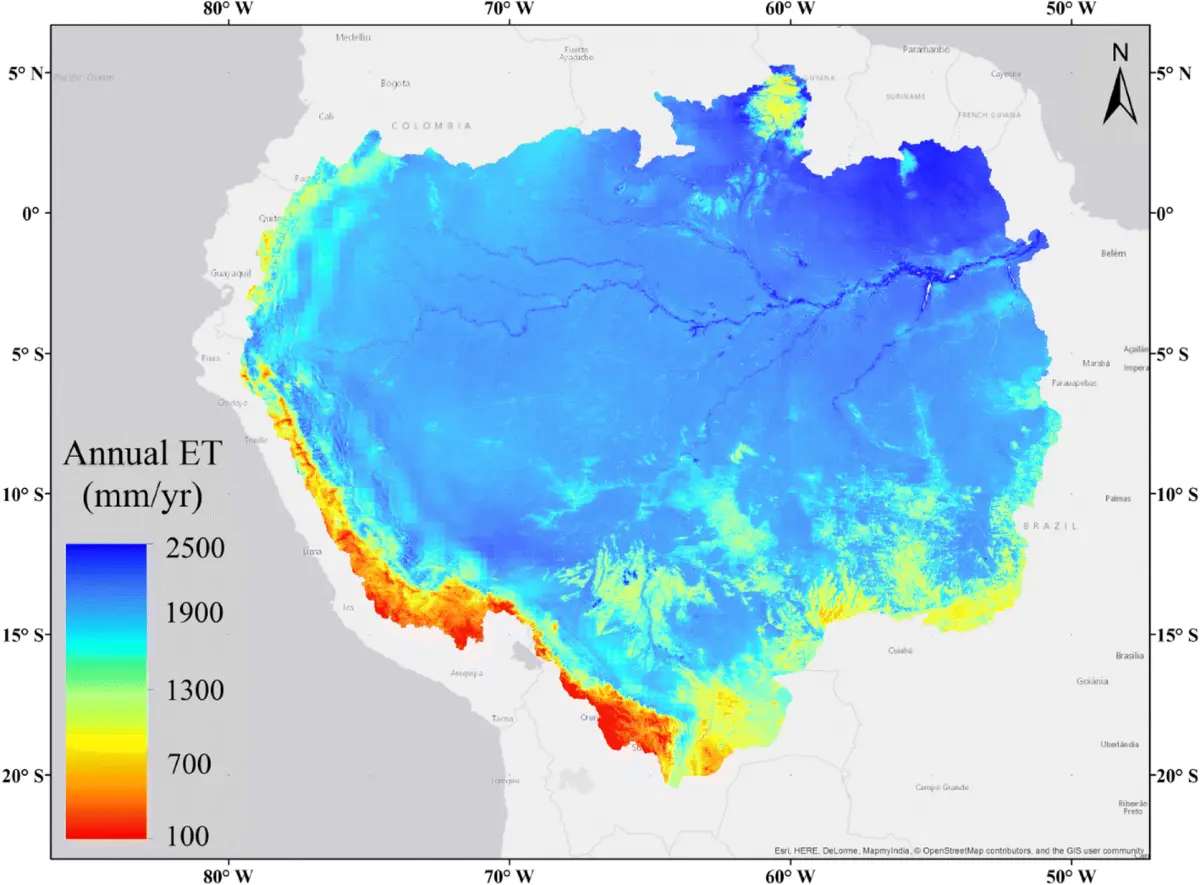
An analysis of 2003–2013 data combined six satellite products and validated them against seven flux towers. It estimated mean basin-wide evapotranspiration at 1,316 millimetres per year. Closed forest returned roughly 1,370–1,380 millimetres per year to the atmosphere, compared with about 925 millimetres over grassland. Values vary by method and location, but the difference shows that replacing forest changes both the land surface and the flow of water above it.
Dr Maya Torres · flux measurement station · central AmazonFictional Code Gaia research layer, explicitly labelled.No rain for four days. The upward water flux above the canopy has not stopped.
The instruments do not see “the forest” as one organism. They see turbulence, heat, carbon dioxide and water vapour. Yet the numbers assemble into an action: the ground received water earlier, trees stored it, and now they are returning it to the air.
Below us, it is dry. Above the canopy, the next stage of the cycle has already begun.
Can the forest's effect on rain be tested?
A map showing forest and rainfall together is not enough: rain helps forest grow, so causation can operate in both directions. In 2012, researchers combined satellite records of rainfall and vegetation with calculated air-mass trajectories. Across more than 60% of tropical land, air that had passed over extensive vegetation in the preceding days produced at least twice as much rain as air that had passed over little vegetation.
This is an observed relationship consistent with forests replenishing atmospheric moisture. It does not make every shower the direct product of particular trees. Convection, ocean temperatures, topography, winds and large-scale climate variability also govern rainfall.
When the pump loses links
The clearest risk may emerge not where a tree disappears, but downwind. Cleared land usually returns less water to the atmosphere. The next forest receives a drier air mass; rainfall weakens and the forest's capacity to transpire falls. A local clearing can therefore propagate a moisture deficit hundreds of kilometres away.
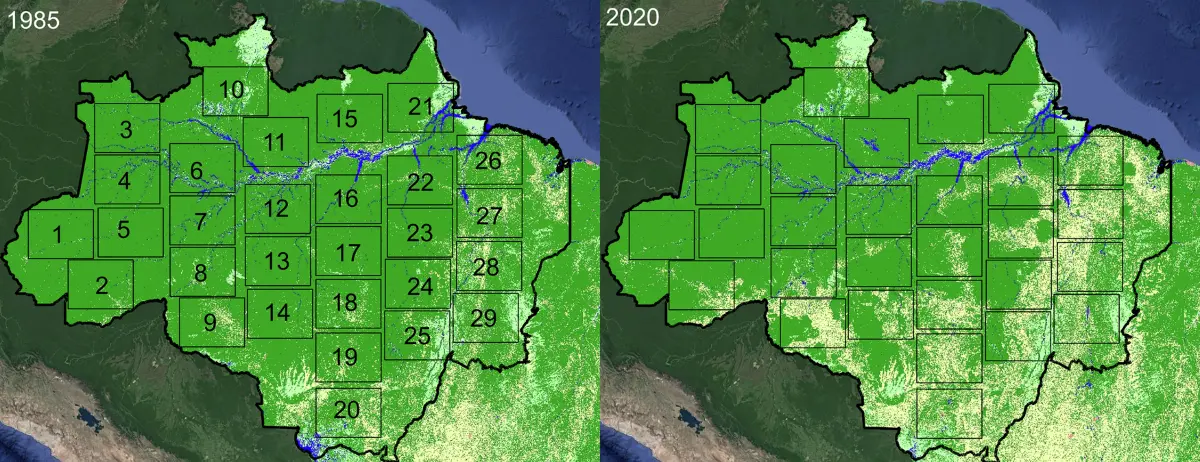
A 2025 study statistically separated the contributions of global climate change and local forest loss across 29 areas of Brazil's Legal Amazon. Between 1985 and 2020, forest cover in the analysed territory fell from 89.1% to 78.7%. Dry-season rainfall declined by about 21 millimetres; the study's model attributed about 74% of that decline to deforestation.
Limit of the finding
The 74% value comes from statistical attribution of dry-season changes in selected areas of Brazil's Legal Amazon. It does not mean that deforestation explains 74% of every rainfall event, every drought, or change across the entire basin.
Dr Elias Veiga · atmospheric tracing groupFictional Code Gaia research layer, explicitly labelled.On the land-cover map, deforestation ends at a hard line. The atmosphere has no such line.
The air entered this sector from the east. It gained moisture above forest. The upward flux weakened over pasture. Two days later, the same air mass reached an area where trees were still standing.
The loss occurred here. The consequence fell as rain—or failed to fall—somewhere else.
What is established—and what remains open
| Status | Finding | Boundary of evidence |
|---|---|---|
| Measured and calculated | The Amazon forest returns an immense volume of water to the atmosphere | Satellites do not measure evapotranspiration directly; estimates combine observations and models. |
| Supported | Some rainfall is recycled repeatedly within the basin | Fractions vary by season, region and method. |
| Observed relationship | Air passing over dense forest often yields more rain | The relationship does not remove the influence of oceans, circulation, temperature or relief. |
| Attribution result | Deforestation substantially reduced dry-season rainfall in the studied areas | The percentage belongs to a specific territory, period and statistical model. |
| Open | Where the threshold lies beyond which the moisture cascade weakens sharply | No single confirmed threshold exists for the whole Amazon. |
An honest conclusion
The title of this file is deliberately provocative, but the physics is more precise than the metaphor. The Amazon does not manufacture water. It receives moisture from the ocean, stores it in soil and wood, releases it through leaves and helps rainfall penetrate deeper into the continent.
Forest and rain therefore cannot be assigned permanent roles as cause and effect. Rain sustains forest; forest sustains the next rain. The danger begins when people remove not isolated trees, but enough of the relay.
Can one local event change the temperature of the whole Earth?
CG-015 · PLANETARY SYSTEMSHow Pinatubo Cooled the PlanetThe Amazon changes the atmosphere continuously through billions of weak fluxes. The next case begins with the opposite: one abrupt injection whose trace enveloped the planet.
Open the next dossier →How high must an emission rise before rain can no longer cleanse it and the atmosphere begins carrying it around Earth?